The Impact of Hybrid Warfare on Security Policies:The Western Balkans & Eastern Europe
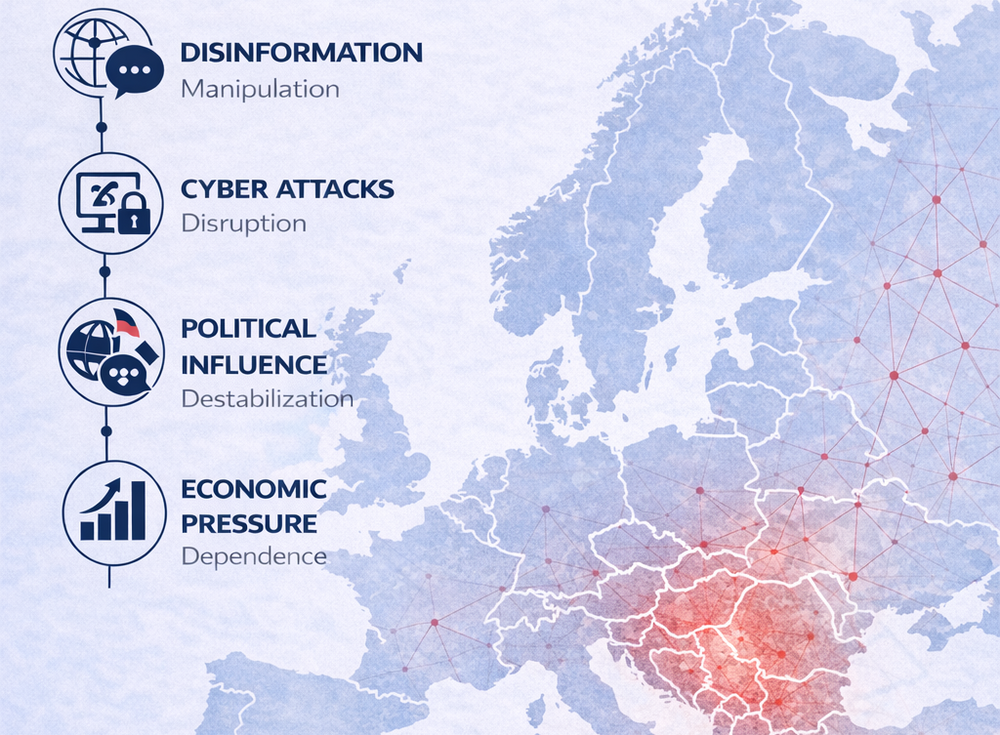
The doctoral research titled “The Impact of Hybrid Warfare on Security Policies: The Western Balkans and Eastern Europe in the Context of the 21st Century” examines the transformation of contemporary security dynamics under the conditions of hybrid conflict. In the evolving strategic environment of the twenty-first century, hybrid warfare has emerged as a multidimensional form of confrontation that integrates conventional military capabilities with non-military instruments, including disinformation campaigns, cyber operations, economic leverage, political interference, and the instrumentalization of social and ethnic divisions. Operating largely below the threshold of open military confrontation, these mechanisms enable state and non-state actors to exert strategic influence, destabilize political systems, and reshape regional balances of power. By integrating theoretical perspectives from security studies and international relations with empirical analysis, the research contributes to the broader scholarly debate on the changing nature of conflict and the strategic implications of hybrid threats for contemporary security governance.
The study focuses on the Western Balkans and Eastern Europe, two geopolitically sensitive regions positioned at the intersection of competing strategic interests between East and West. Within this context, the research analyzes how hybrid pressures affect the evolution of national security policies, institutional resilience, and patterns of international alignment. Particular attention is devoted to the ways in which states recalibrate their strategic responses by strengthening cyber and defense capacities, reconfiguring institutional frameworks, and intensifying cooperation with international actors such as the European Union and NATO. Through this analytical framework, the study offers a geo-strategic perspective on how states situated in contested security environments adapt to complex, multidimensional, and increasingly ambiguous threats that characterize the contemporary international system in the 21st century.
Denur Paçaku is a PhD candidate in Political Science at the Faculty of Contemporary Social Sciences, South East European University. He holds a bachelor’s and a master’s degree in Political Science from the University of Prishtina. His doctoral research, titled “The impact of hybrid warfare on security policies: The Western Balkans and Eastern Europe in the context of the 21st century,” examines how hybrid threats shape security policies and international relations in these regions.
Beyond his doctoral research, he has participated in various research initiatives, academic training programs, and schools of political thought, and has also been involved in several international projects. His broader research interests include international relations and diplomacy; European studies, foreign policy, and human rights. Paçaku comes from Kosovo and is a PhD researcher at the Centre for Southeast European Studies at the University of Graz, Austria