BB: Two Generations of Resistance - Student Movements in Serbia in the 1990s and Today
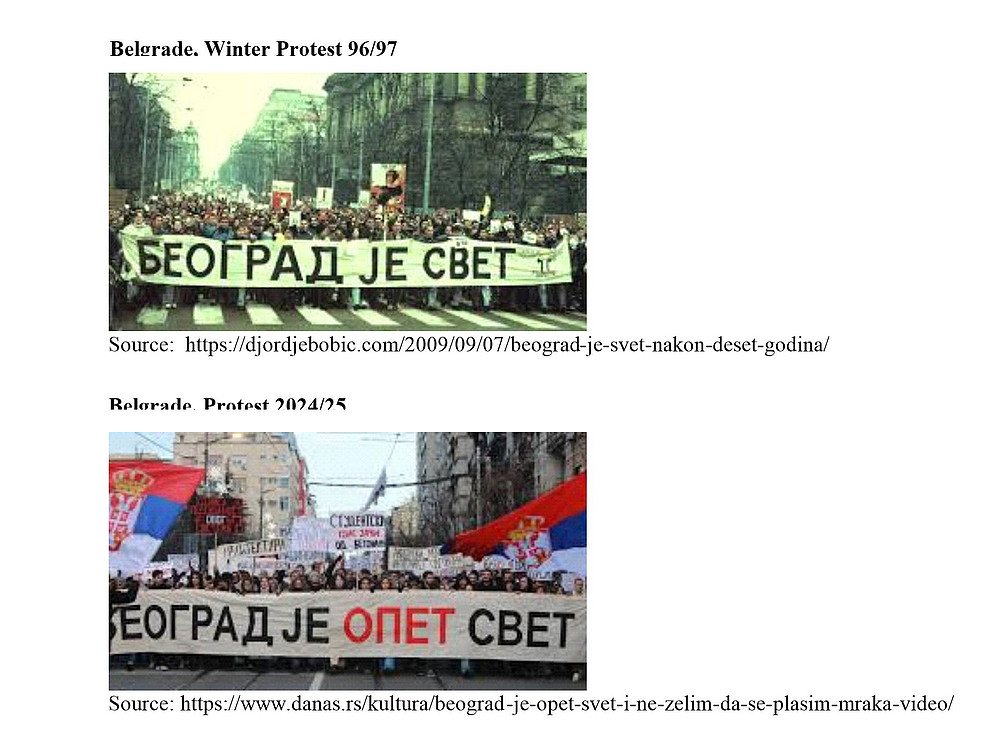
The image is a collage consisting of two photographs placed side by side. Both photos show large crowds of people participating in street demonstrations in Belgrade, Serbia.
This lecture analyzes the transformation of the role of opposition actors and student movements in mobilizing against a consolidated hybrid regime in Serbia, through a comparative study of protest waves from the 1990s and the contemporary student protests of 2024, triggered by the tragedy in Novi Sad. While earlier waves of contention were structured around opposition parties as the primary political agents, recent developments suggest a reversal: students increasingly act as autonomous political subjects capable of articulating demands, framing public discourse, and shaping the direction of collective action.
Additionally, the lecture explores what sustains their mobilization and what distinguishes it from other protest waves. Particular attention is devoted to the emergence of a shared political idea - a collectively imagined state in which participants wish to live, understood as democratic, accountable, and institutionally functional. The argument is that the 2024–2026 mobilization moved beyond a spontaneous reaction to injustice: through moral shock, collective experience, and digitally mediated solidarity, protest participation became a process of civic formation. Students thus did not position themselves against the state, but as its rightful custodians, seeking to reclaim institutional legitimacy rather than reject political community itself.
By combining theories of social movements, generational change, and micro-sociological approaches to mobilization, the lecture highlights both continuity and rupture in Serbia’s protest tradition. The comparison with the 1990s demonstrates a shift from opposition-centered mobilization toward movement-centered legitimacy, suggesting broader transformations in how political authority is contested in hybrid regimes.
Andrijana Lazarević is a Teaching Assistant at the Department of Political Science, Faculty of Political Sciences, University of Belgrade. Her research interests include comparative politics, social movements, democratization, and democratic innovation. She is currently pursuing a PhD focusing on the role of contemporary social movements in addressing and overcoming the crisis of political legitimacy in Western democracies. She is a member of the European Cooperation in Science and Technology (COST) Action “Linking Euroscepticism and Populism: Causes and Consequences (EUPopLink)”.